
Webinar series Digital Inclusion and Migration
The DigiMig Webinar Series brings together leading scholars in media and migration studies to discuss how digital technologies shape inclusion, inequality, and everyday life across migrant generations. Organized by the DigiMig research team at the University of Groningen, these webinars explore themes such as digital literacy, intersectionality, wellbeing, and transnational networks.
About the webinar series
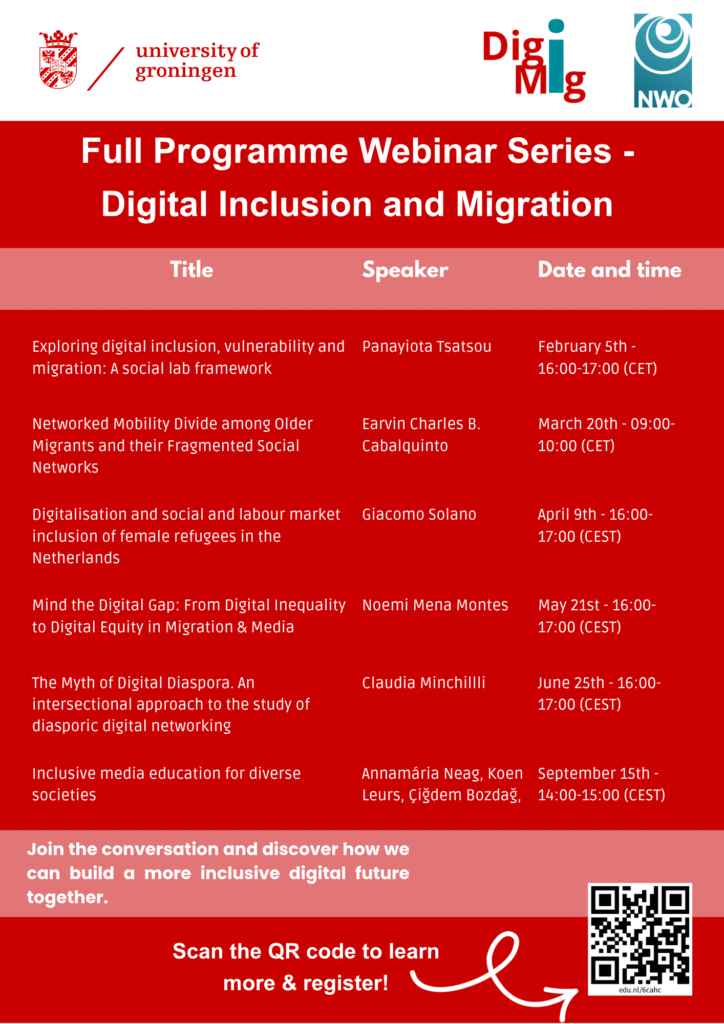
From fall 2025 the first webinar will take place in the Digital Inclusion and Migration webinar series. Topics covered include for example: digital migration, transnational ageing migrants, intersectionality, gender, newcomers, digital wellbeing in schools. The series will consist of 6 webinars in total ranging from November 2025 to June 2026.
The Webinar Series aims to create a space for exchange and reflection on how digital technologies shape experiences of migration, belonging, and participation. By bringing together research from different disciplines and countries, the series highlights diverse perspectives on digital inclusion — from education and labour integration to gender and ageing. The series are welcome to all who are interested.
About DigiMig
The DigiMig project is led by Assoc. Prof. Dr. Çiğdem Bozdağ at the University of Groningen. It investigates from an intersectional perspective how social and cultural factors influence digital inclusion in the Netherlands with a focus on migration together with other factors. The project focuses on three key areas:
- How digital media is used by families with a migration history, with attention to both parents and children.
- How digital inclusion policies take cultural diversity into account.
- How digital literacy is taught in schools with diverse student populations.

Next webinar
Noemi Mena Montes (Radboud University, the Netherlands)
“Mind the Digital Gap: From Digital Inequality to Digital Equity in Migration & Media“
21/05/2026 4 PM CET (Amsterdam)
Read more
As an Investigative Journalist-Researcher, I focus on migration, the media’s portrayal of refugees, and the role of digital platforms in integration. My work aims to uncover systemic barriers that refugees face, highlighting how media shapes public perception and policy. I also emphasize issues like the digital divide, refugee rights, and the power of storytelling in shaping policies that impact migrant communities.
My research focuses on the intersection of migration, communication, and digital inclusion, particularly in relation to refugees and migrants. I examine how digital platforms can serve as powerful tools for empowering migrant communities and fostering their integration into host societies. The digital divide remains a critical barrier, as many refugees and migrants face significant challenges in accessing and utilizing digital resources, which limits their ability to navigate essential services, connect with their communities, and participate fully in society.
Missed one of our previous webinars?
No worries!
All previous webinars are now streaming on our YouTube Channel ‘@DigiMig-RUG’. Watch the most recent one by Giacomo Solano on ‘Digitalisation and social and labour market inclusion of female refugees in the Netherlands’ here. Click on ‘more videos’ to see the playlist, including all webinars.
Registration
Lecturers, researchers, PhDs, students, and other interested parties are invited to participate in the sessions. Registration is open for all sessions. Please register by clicking the button above. We will send you the details to follow the webinars via email. For questions regarding the webinar series, please contact Denise Mensonides (d.mensonides[@]rug.nl) or Cigdem Bozdag (c.bozdag[@]rug.nl).