
In May 2025, Denise, the postdoctoral researcher on the project, had the opportunity to engage with a range of scholars exploring the intersections of (digital) media practices, digital inclusion, migration, and diversity. In this blogpost, she highlights the rich diversity of the projects and reflects on the complex ways in which technology, migration, identity, and inclusion are interwoven within the Australian context. She concludes the blog by sharing her overarching observations.
The Australian Context: The Immigration Museum
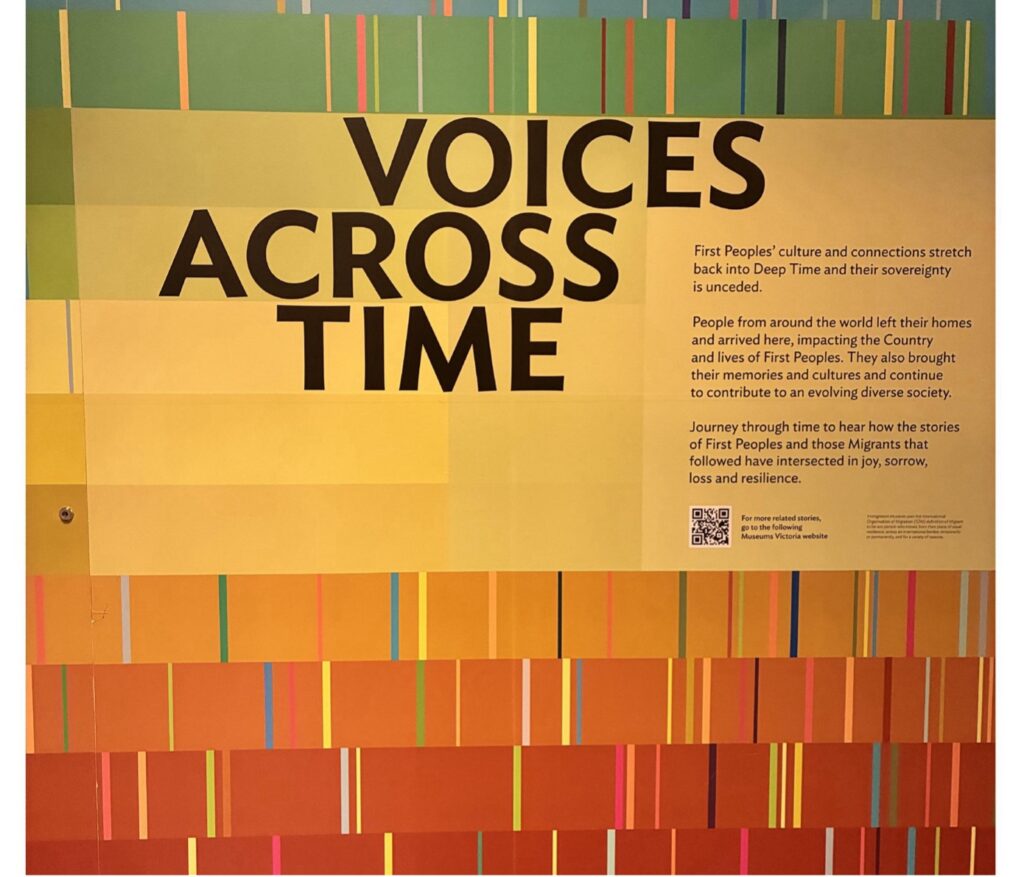
The morning after my arrival, I immediately visited the Immigration Museum, located in the Old Customs House in the city centre of Melbourne. This impressive space offers a thoughtful exploration of migration in the Australian context, with a particular focus on Melbourne and the state of Victoria. The exhibitions trace the complex and often fraught history of migration — from the arrival of British colonizers in the 18th century to the introduction of the 1901 White Australia policy, which sought to restrict non-British immigration.
What makes the museum especially impactful is its focus on personal stories. Instead of presenting migration only through the lens of policies or political discourse, the exhibitions centre the lived experiences of migrants and refugees. These stories vividly convey the ongoing negotiations of belonging, identity, power, politics, and racism in Australia. They reveal how individuals make sense of arriving in a new country, navigate inclusion and exclusion, carry memories of the past, imagine their futures, and demonstrate resilience and agency throughout these complex journeys.
Everyday Media Practices Throughout The Life Span: Insights from Dr. Andy Zhao (Deakin University) and Dr. Earvin Charles B. Calabquinto (Monash University)
This focus on lived experiences is also central in both the work of dr. Andy Zhao and dr. Earvin Cabalquinto. Dr. Zhao is a Research Fellow at the Australian Research Council Centre of Excellence for the Digital Child (Deakin Node). In his research, dr. Zhao explores media practices in families from diverse cultural backgrounds, including those of young Chinese migrants. In his book ‘Social Media in the Lives of Young Connected Migrants’, he explores what it means for young migrants to live in a digital age. The book explores the complex online social networks that shape the everyday lives of Chinese international students. It shows how these young migrants experience, create, and challenge different kinds of boundaries — such as managing privacy, disconnecting from social media, and shaping their online identities. Dr. Zhao argues that these experiences are not the same for everyone. Instead, how students deal with these boundaries depends on their personal goals, situations, and the social, cultural, and material conditions of the country they live in. In addition, he argues that online activities are closely connected to offline circumstances, including power dynamics, cultural expectations, and social relationships.
Also exploring everyday life digital media practices is dr. Earvin Charles B. Cabalquinto. is an Australian Research Council DECRA Research Fellow and Senior Lecturer in the School of Media, Film and Journalism at Monash University. While dr. Cabalquinto has a broad research interest into the intersections of digital media, (im)mobilities and migration, this blogpost will highlight his ARC DECRA project. In this project, he explores the digital divide by focusing on the homes of ageing migrants as key spaces where digital exclusion is experienced and negotiated. Working closely together with elderly Filipino-Australians and their family members, he explores the consequences of digital divide on their personal and social wellbeing. An important expected outcome that I want to highlight in this blogpost is that with this project, dr. Calabquinto aims to formulate culturally appropriate recommendations and resource materials for ageing migrants, migrant communities, policy makers, and stakeholders, with the goal to enhance ageing migrants connective capacities to navigate a secure digital landscape. Building on everyday life experiences and practices to formulate culturally appropriate policy recommendations represents an important step toward ensuring that policies and resources genuinely reflect the realities, needs, and challenges faced by people from culturally diverse backgrounds.
Digital Technology Use During Resettlement – Recent Research by Dr. Charishma Ratnam (RMIT University)
After meeting with dr. Zhao and dr. Cabalquinto, I had an insightful conversation with dr. Charisma Ratnam. Dr. Ratnam is a Senior Research Fellow at the Social Equity Research Centre in the School of Global, Urban and Social Studies, at RMIT University in Melbourne. In her research, she explores diverse dimensions of refugee resettlement. In the past, she has worked with Sri Lankan migrants to better understand how they use and encounter public spaces in cities around Australia, as well as co-designed COVID-19 communication strategies with, and for, young people from culturally and linguistically diverse communities in Victoria. It is through these projects that she has developed her research program centring migrants, refugees, and asylum seekers. Her most recent project builds on this work by investigating how refugees use digital technologies throughout the resettlement process. This includes developing new research methods to better capture their experiences and producing fresh insights into how smartphones, apps, and other digital tools help refugees meet their practical and social needs as they build new lives in Australia.
As this project only began in 2025, we look forward to the valuable knowledge it will generate in the coming years — knowledge that can inform more responsive policies, services, and support systems to improve the resettlement journey for refugees in Australia.
Informing Policy Through The Digital Inclusion Index – Conversations with dr. Kieran Hegarty (RMIT University) and Assoc. Prof. dr. Sharon Parkinson (Swinburne University of Technology)
My final meeting took place at the ADM+S Offices, an inspiring co-working space where researchers from different universities work within the ARC Centre of Excellence for Automated Decision-Making and Society. ADM+S brings together universities, industry, government and the community to support the development of responsible, ethical and inclusive automated decision-making. One of the projects in the centre is the Australian Digital Inclusion Index. Both dr. Kieran Hegarty and Assoc. Prof. dr. Sharon Parkinson work on this survey-based research project. The Australian Digital Inclusion Index uses survey data to measure digital inclusion across the dimensions of access, affordability, and digital ability. While this gives an insight into the overall level of digital inclusion in Australia, this project also sheds light on how these dimensions vary across different regions in the country, as well as across different social groups. In addition, their work on the Digital Inclusion Index, which is conducted across the years, incorporates major societal moments and shifts in society. For example, it has explored the impact of the COVID-19 pandemic, and in the most recent version, will explore the rise of generative AI. Some interesting key findings of the project is that while digital inclusion at the national level continues to steadily improve, there remains a considerable gap between First Nations and non-First Nations people in Australia. In addition, this gap is particularly pronounced when people live remote to very remote. Finally, mirroring findings in other countries, the Australian Digital Inclusion Index shows that digital inclusion is related to a variety of factors, including age, level of education, employment, and income. And while this project mainly uses quantitative data, other projects within the centre also take a qualitative approach to understand the needs and uses of different communities across Australia. One of these projects is ‘Mapping the Digital Gap’, through which the digital inclusion and use of media in remote First Nations communities across Australia is being researched. People living in these communities are among the most digitally excluded Australians, often facing limited access to digital infrastructure and services, along with high costs for connectivity. Through face-to-face surveys, annual ethnographic research, ongoing collaboration with community agencies, and regular site visits, this project seeks to generate in-depth insights into the state of digital inclusion across remote Indigenous communities and to monitor changes over time. These findings are used to guide the development and assessment of local strategies to improve digital inclusion and to inform government policy.
Overarching Observations: The Gap Between Policy and Lived Experience
What connected all these meetings was a shared attention to the situated, everyday realities of migrants and minorities in Australia. While policies are often based on universal principles – ‘universal access,’ ‘promoting digital skills’ – research repeatedly shows that one-size-fits-all solutions rarely work. The gap between policy frameworks and the lived experiences of people remains wide. However, all the researchers who graciously agreed to meet with me and tell me about their research are actively working to bridge the gap between policy and practice, and to contribute to a safer, more accessible, and more inclusive digital society for all. Whether it is about family media habits, young migrants, elderly migrants, resettlement, or local digital inclusion challenges – their work shows the importance of taking seriously the voices, needs, and lived realities of migrants, refugees, and marginalised communities.
My time in Melbourne made it clear that digital inclusion goes far beyond devices and internet connections; it’s also about whose voices are heard, whose experiences matter, and who holds the power to shape the digital spaces we all depend on.