
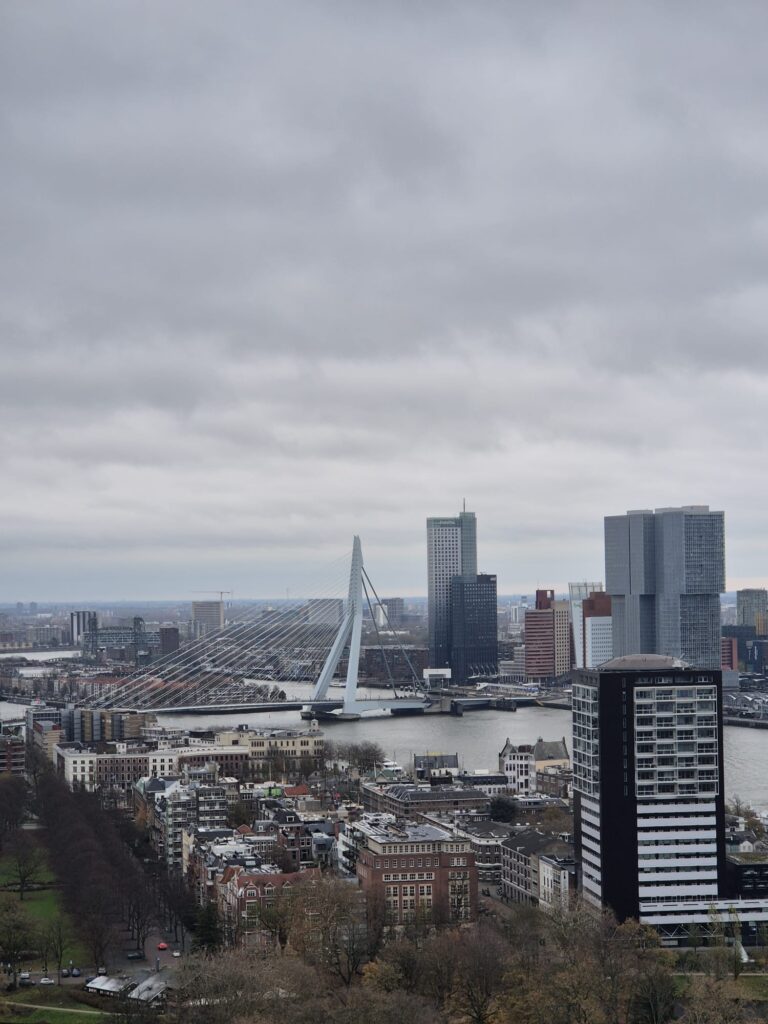
As part of Rosa’s PhD research within Digimig, she lived in Rotterdam for 6 months to do interviews with families, among other things. During that period she spoke with twenty families (with a focus on Turkish-Dutch, Moroccan-Dutch and Surinamese-Dutch) in Rotterdam and others, each time with a parent and a child between 8 and 15 years old. Below is a reflection on this field work period.
It soon became clear to me that Rotterdam invests a lot in digital inclusion and inclusion in general. There is not only a municipal level policy, but also a fairly extensive network of organizations and initiatives that all do something locally and regionally with digital inclusion. Through the network digital inclusion, among other things, I came into contact with various parties such as the Rotterdam Library, SPIOR, Wijkstation and Goud van Noord.
What strikes me is that a lot of support in the field of digital literacy is organized locally per neighborhood. Much is organized in houses of the neighborhood, libraries and neighborhood centers, this is often close to home and more embedded in existing social structures. That makes it accessible and very open, but at the same time also complicated to keep the overview.
In the conversations with families, it was striking how strong daily life often takes place within their own neighborhood. Activities for children, sports lessons, support for parents, social contacts, a lot happens in the neighborhood. That is not only practical but also related to a feeling of trust and familiarity. This strong neighborhood orientation also means that access to support is often done via informal networks. People know where to find each other, but that often happens via via.
In addition to (non) formal courses such as smartphone and computer courses, developed via learning programs other forms of learning are also visible. An example that stayed with me is the Tea Time ‘learning with the neighbors’ digitization project by Ömer Hünkar Ilik in which digital skills are shared in an informal setting, at home. There is no strict model, but coming together, talking, and in the meantime learning from each other. Initiatives such as these build on existing relationships and show that digital inclusion is also something collective.
At the same time, there is a tension between what is and what is found by people who can use help with digital skills. There is a lot of offer, courses, consultation hours, support, but it is not obvious for people with fewer digital skills to find this. ‘Access’ is therefore not something that only has to do with online or physical visibility, but also with accessibility in people’s daily lives. For example, is there also an offer for people in the evenings? Or in languages other than Dutch?
What also struck me is that structural support around digital education seems less present. There are certainly individual initiatives and online webinars, and parents’ evenings, but I did not find a continuous local offer for parents and children related to media use and upbringing. This is interesting, because it is precisely in the conversations with parents and children that digital upbringing was a recurring topic of both screen time and online contact.
Reflections of the fieldwork
The interviews themselves took place in all kinds of settings: at the kitchen table, on the couch, on the floor, sometimes with the whole family, sometimes in a separate room, and occasionally at a location such as a library or neighborhood center. A large part of the interviews coincided with Ramadan. Although that meant that there was no eating or drinking during the day, I was often welcomed with an obvious hospitality. Twice I was even invited to eat during the Iftar. Moments like that make an impression, precisely because I was taken as a researcher and outsider. At the same time, the field work also brought questions about my own position. As a white, highly educated researcher, without children, I come to people’s homes in their private sphere. I am aware of the inequality that may be in it. Sometimes little things helped make the conversation a little more reciprocal, such as bringing Frisian sugar bread (that’s where I come from) or sharing things about my own background and how I grew up, as well as sharing similarities.